
D-Tools Cloud
Inventory Management Frequently Asked Questions
D-Tools Cloud includes two levels of inventory capability: our standard D-Tools Cloud Inventory Pools and our more advanced D-Tools Cloud Inventory Asset Management. Here are some FAQs to help you determine which solution is right for you.
Overview & Pricing
What is D-Tools Cloud Inventory Management?
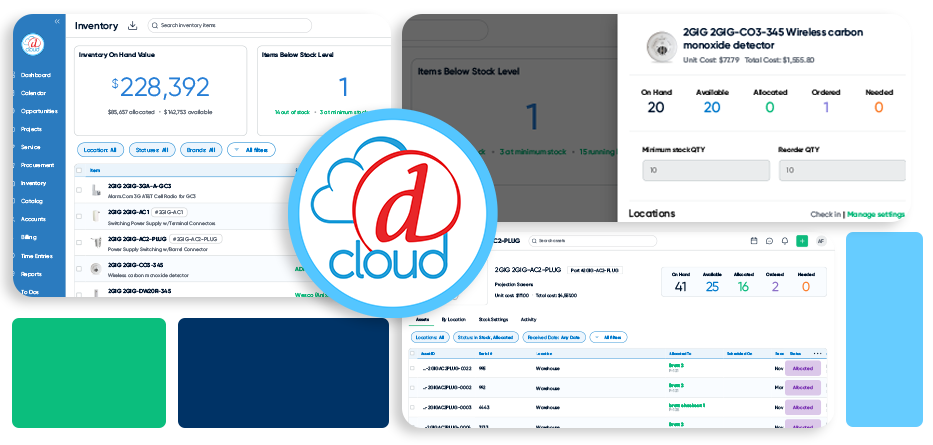
D-Tools Cloud Inventory Management provides integrators with a seamless solution for tracking and managing inventory. It includes tools for purchasing, receiving, tracking, and allocating inventory, making it easier to complete projects on time and within budget.
What is Inventory Asset Management, and how is it different?
Inventory Asset Management moves D-Tools Cloud from count-based stock management to true per-unit asset tracking. Every physical item gets its own digital identity, including serial number, warehouse location, project assignment, actual unit cost, firmware version, MAC and IP addresses, and a complete asset history. While standard Inventory Management aggregates items into product-pooled totals, Inventory Asset Management tracks the exact unit.
Read more about Inventory Asset Management
Is either feature included in my D-Tools Cloud subscription, or is there an extra cost?
Both Inventory Management and Inventory Asset Management are included with your paid D-Tools Cloud subscription at no additional cost. Additional users can be added to your subscription for an additional fee.
Do I have to use Inventory Asset Management, or can I keep using standard Inventory Management?
There is no requirement to use Inventory Asset Management. You can continue using D-Tools Cloud’s existing Inventory Management module to track product quantities. Inventory Asset Management is available whenever your business is ready.
Key Benefits & Who It’s For
What is D-Tools Cloud Inventory What are the key benefits of using Inventory Management?
Inventory Management helps your business:
- Streamline purchasing workflows.
- Ensure items are available when needed.
- Improve organization across warehouses, vans, and job sites.
- Prevent stock shortages with automated re-order alerts.
- Optimize cash flow and labor efficiency.
Why should I adopt Inventory Asset Management?
Most inventory systems tell you how many — Inventory Asset Management tells you which one. Per-unit tracking assigns every unit its own unique ID, serial number, audit trail, and lifecycle history from receipt to post-install service. The result is faster warranty resolution, accurate job costing, tighter warehouse operations, and a single source of truth connecting purchasing, project allocation, field installation, and service.
Learn more about Inventory Asset Management features
Who in my organization benefits from these features?
Inventory Management is designed to support business owners, project managers, service managers, field technicians, procurement teams, and accounting staff. Inventory Asset Management delivers the most value to firms that manage:
- Product installation and service workflows by serial number
- Large-scale warehouse operations
- Service calls that need to identify the exact unit installed
- Compliance, audit, or chain-of-custody requirements
- Detailed project costing and profitability analysis
- Long-term customer asset management
Do I need to be a certain company size to benefit from Inventory Asset Management?
No. Inventory Asset Management is built for AV professionals of any size who need to know exactly which unit is on which shelf, allocated to which room, installed at which customer location, and still under warranty on which P.O.
Tracking, Scanning & Receiving
What types of items can I track?
Both our standard Inventory Management and advanced Inventory Asset Management features allow you to track both project-specific items and stock items, including equipment, consumables, and other assets. Inventory Asset Management extends this to per-unit tracking with serial numbers and asset history. For bulk consumables (wire, cable, mounting hardware, batteries, etc.) that don’t require individual labels, standard pooled tracking remains the recommended approach.
How do I receive items into inventory, and what devices can I use?
You can use a handheld device or most smartphones to scan barcodes or QR codes for quick and accurate inventory updates. Scanned items can be assigned to specific locations — such as warehouses or job sites — in real time. Compatible handheld barcode and QR code scanners also work.
Do I need a barcode scanner to use Inventory Asset Management?
No, a scanner is not required, but it will make intake significantly faster than typing serial numbers or asset IDs manually. Once scanned in, you can also use your mobile phone camera to scan cataloged product UPC codes and review inventory locations by product.
Can I scan multiple items at once, or does each one need to be scanned individually?
Inventory Asset Management includes batch mode, which lets you scan multiple items and move or allocate them in a single action. Bulk serial-number capture auto-advances field to field so a clerk can intake a full P.O. without touching the mouse.
What information should be on the product labels generated by Inventory Asset Management?
You can include whatever you want, but the ideal label contains: serial number, project name, scheduled install date, warehouse location, and notes.
Location Management & Allocation
How does location management work?
Location management lets you track and transfer items between multiple locations such as warehouses, vans, and job sites. Locations can be specified down to five tiers (warehouse → aisle → bin → shelf → tray), which expedites accessibility and keeps inventory organized.
Can I allocate inventory to specific projects?
Yes. You can reserve and allocate inventory to specific projects, ensuring items are available when needed in the field. You can also allocate items for stock replenishment.
Does inventory tracking follow items as they move through a project?
Yes. The system provides real-time tracking of inventory as it moves from purchasing through receiving, staging, rack assembly, and delivery to the job site.
Stock Alerts & Customization
Can I set up alerts when stock levels are low?
Yes. You can designate minimum stock levels, and re-order alerts are triggered automatically when inventory falls below the threshold. This helps prevent running out of essential materials.
Can I customize inventory settings for my business?
Yes. D-Tools Cloud Inventory Management allows you to customize item locations, stock thresholds, and allocation rules to fit your business processes.
Integrations & Getting Started
Can I integrate inventory with my existing tools or systems?
D-Tools Cloud Inventory Management works seamlessly within the D-Tools Cloud environment. For details on integrations with QuickBooks, Xero, and other third-party solutions, visit the D-Tools Cloud Help Center.
How do I get started?
Getting started is easy. Check out our Quick Start Guide for step-by-step instructions on setting up and using Inventory Management in D-Tools Cloud.
Access the Inventory Quick Start Guide