

Replacing a tired hot-water heater is one thing. Losing it 4 days before the warranty expires is quite another. Mine recently bowed out at 6 years, 11 months and 26 days. Thankfully, the manufacturer stood by the warranty. This domestic drama arrived on the heels of a costly refrigerator failure at year six, plus a fancy drawer microwave that tapped out after just four years. The days of the 30-year appliances our parents owned are long gone.
It begs the question for our industry. If major appliances now live fast and die young, how long can clients reasonably expect their smart home systems to last? They happily swap phones every few years, but a whole-home lighting or control system? In their minds, that should last nearer to a generation than a gadget cycle.
"Nothing lasts forever, especially in a sector driven by software updates, security patches and wireless standards that turn over faster than a head coach in college football."
Kaine Pritchett, managing director of Virtus Integration in Telford, UK, tackles that mindset head-on. After receiving a service call on a project he completed in 2008, the homeowner put him on the spot, asking: “What happens when a system gets old?”
It’s a simple question, but one that cuts to the heart of modern integration. Nothing lasts forever, especially in a sector driven by software updates, security patches and wireless standards that turn over faster than a head coach in college football.
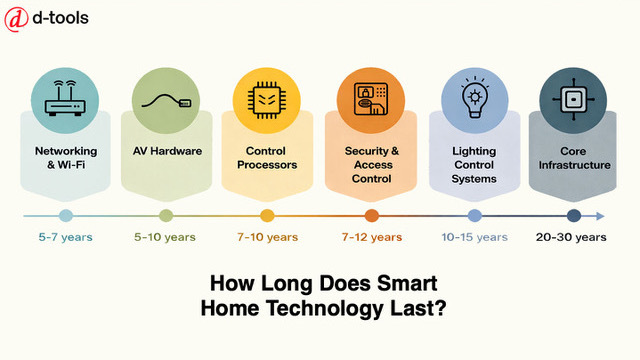
Rather than dodge the conversation, Pritchett leans into it. He developed a clear, honest lifespan guide for the systems he installs. It is refreshingly blunt, and integrators may find it a useful benchmark when setting expectations.
Core Infrastructure (Cabling, Fiber): 20 to 30 years
If the backbone is designed and installed properly, it endures. Like good foundations on an older home, this is where long-term value sits.
Lighting Control Systems: 10 to 15 years
Modules can be serviced, swapped and updated, but eventually the march of technology leaves older platforms behind. Even the best systems don’t outrun progress.
Networking & Wi-Fi: 5 to 7 years
Standards like Wi-Fi 6, 6E and now 7 move quickly, and so does the bandwidth coming into U.S. homes. Old routers simply can’t keep up.
Control Processors: 7 to 10 years
The brain evolves. Firmware changes, security hardens, integration methods shift. At some point the old dog stops learning new tricks.
AV Hardware: 5 to 10 years
HDMI versions, HDR formats, streaming codecs. All change, all the time. Clients expecting their decade-old hardware to handle today’s sources will feel the squeeze.
Security & Access Control: 7 to 12 years
Cameras, intercoms and door stations improve rapidly. Increased resolution and better analytics can make older gear feel quaint.
Losing a lighting keypad is not as brutal as what I had to experience taking cold showers for three days, but system downtime still stings. Your customers rely on their tech for comfort, convenience and peace of mind. When it hiccups, the household feels it.
That is why integrators should talk about lifespan early… not as fearmongering, but as practical stewardship. Discussing realistic lifespan timelines builds trust and opens the door for something many integrators under-utilize: service agreements. If clients know their systems will age, they are far more willing to invest in ongoing care. D-Tools Cloud's Service Plan Management Suite and D-Tools System Integrator's(SI) Field Service Management can help you manage service agreement efficiently (and profitably).
The technology may not last forever, but the relationship with your client can.
