
There’s a myth in the custom installation industry that proposals are just a simple administrative task between a good sales conversation and a signed contract. All you need to do it get the scope of work roughly right, polish the cover page, send it off, and let the relationship do the heavy lifting. But the data says otherwise.
Looking at aggregated 2025 data from D-Tools Cloud, one thing becomes clear very quickly: as projects get larger and more complex, the proposal becomes the single biggest lever you have over maintaining a reasonable sales cycle, maintaining your margin, and elevating customer satisfaction. If you get it right, everything downstream improves; if you get it wrong, the wheels start coming off.
Number of Proposal Revisions
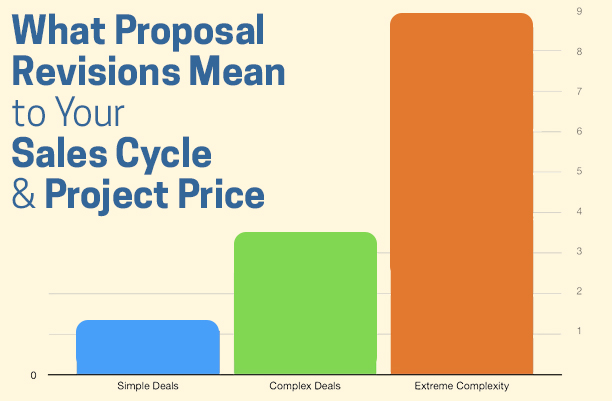
Let’s start with revisions. On simple jobs with fewer than 10 line items, the average opportunity requires just 1.08 proposals. That’s effectively one-and-done. But once you move into complex territory, 50 line items or more, that number jumps to around three proposals per deal. That’s a bit annoying, but still manageable.
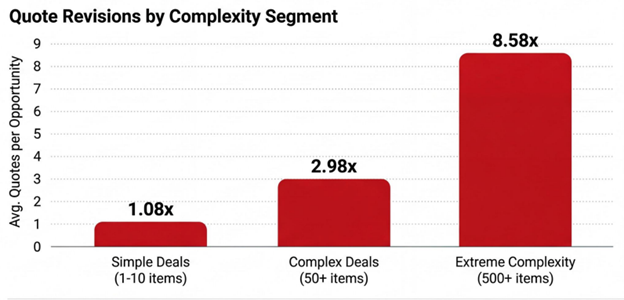
It’s when you get to highly complex projects with 500 line items or more that things get scary. Here, the average number of proposals ranges from eight to nine. That’s not refinement, that’s rework. And rework is expensive, even before you factor in the opportunity cost of what your team could have been doing instead.
Longer Sales Cycle
Revisions don’t happen in isolation. They stretch the sales cycle. Simple proposals are accepted, on average, in just 18 days. That’s fast, decisive, and healthy for cash flow. Highly complex proposals take an average of 86 days to close. Nearly three months of back-and-forth, scope changes, and second-guessing.
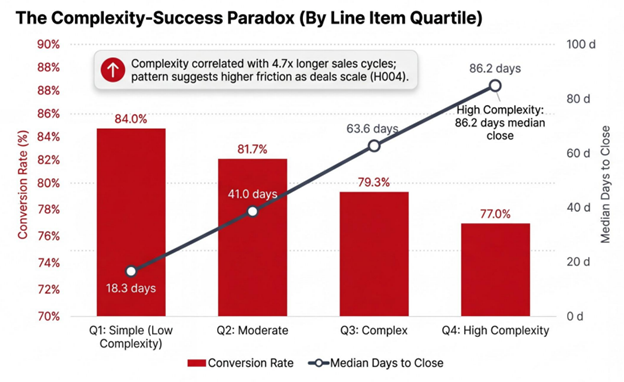
Every revision resets the clock. Every clarification introduces friction. The longer a deal drags on, the more chances there are for something to go wrong.
Price Erosion
Lastly, there is often discounting taking place in every quote. Across all proposals, regardless of size, 67% experience some form of value engineering or discounting. More than half, 56%, see a price reduction of 10% or more. That’s already sobering. But on larger projects, where revisions pile up and timelines stretch, discounting becomes almost inevitable. By the time a proposal has been revised half a dozen times, the conversation has often shifted from value to cost. At that point, you’re negotiating against your own document but hopefully you are maintaining your margin in every version.
These three factors feed each other. More complexity leads to more revisions. More revisions extend the sales cycle. Longer sales cycles increase the likelihood of discounting. Discounting erodes margin. Margin pressure forces shortcuts. Shortcuts lead to errors. And errors lead to, you guessed it, more revisions.
This is why proposal creation cannot be treated simply as an administrative task, especially on larger jobs. It is not something to hand off to the least senior person in the room or rush through at the end of a long sales process. Your proposal is where scope discipline lives. It’s where expectations are set, assumptions are made explicit, and value is defended.
The best-performing integrators I speak with treat proposals as a strategic capability. They invest in accurate data, consistent structure, and repeatable processes. They aim to get it right early, knowing that every avoided revision saves time, protects margin, and builds confidence with the client.
The challenge for integrators is simple, but uncomfortable: benchmark yourself against these numbers. How many times do your complex proposals get revised? How long do they really take to close? How often do you cave on price, and by how much? If your figures are worse than the benchmarks, it’s not bad luck. It’s process.
