


For years, the residential integration channel has defined itself by what it isn't: it isn't electrical contracting, it isn't plumbing, it isn't framing. It's the low-voltage trade… at the wiring level, it is carrying the signal, not the current. But a look at project data pulled from D-Tools Cloud for the first six months of 2026 suggests that line between line voltage and low voltage has been getting blurrier for a while, and integrators may be doing more electrical work than the industry's self-image accounts for.
Across all equipment specified in D-Tools Cloud projects during the first half of the year, line-voltage electrical and lighting equipment accounted for 8.39% of total equipment dollars. That's not a rounding error. It's a meaningful, measurable slice of the average integrator's business, and it's concentrated in a few very telling places. It appears more integrators are installing electrical boxes, breakers, fixtures, dimmers, transformers, and power-protection gear that traditionally sat on an electrician's side of the ledger.
Where the Line-Voltage Dollars Are Going
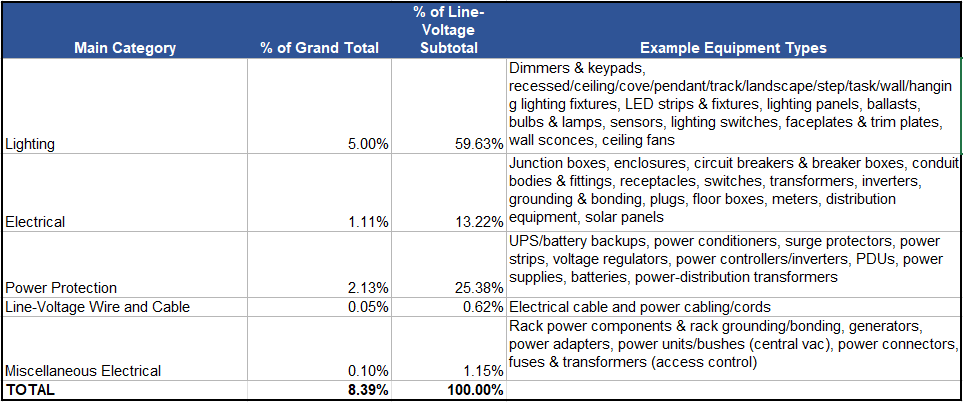
Lighting (excluding lighting control) alone makes up nearly 60 cents of every line-voltage dollar an integrator specifies.
Zoom into the sub-category detail and the picture sharpens further:
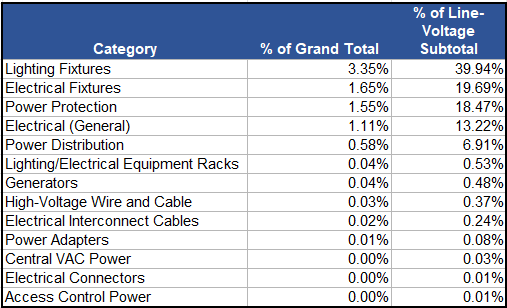
The takeaway isn't just "integrators do some electrical work." It's that lighting, specifically, has become the connective tissue between the low-voltage and line-voltage worlds. Every house needs lighting. Not every house "needs" a distributed audio system or a home theater. Those remain discretionary, budget-sensitive line items. Lighting is not discretionary, which makes it the most reliable crossover category in the business and a natural on-ramp for integrators looking to expand their scope of work.
Two Trades, Converging
This data is really a symptom of a broader shift: the line between the low-voltage integration market and the traditional electrical trade is dissolving from both directions. More integrators are pursuing electrical licenses so they can pull permits and install fixtures, panels, and dimming systems themselves rather than subcontracting that work away. At the same time, more electricians are moving into low-voltage, running structured cabling, mounting access points, and installing security and smoke devices. That trend is occurring because the tools, certifications, and margins have become accessible enough to make it worthwhile.
The strategic logic behind this convergence is often summarized as wanting to "own the ceiling." A single contractor can install the speakers, the lighting fixtures, the wireless access points, and the smoke detectors in every room. That means they are consolidating a half-dozen trade relationships into one truck roll, one crew, and one point of accountability.
Why "Owning the Ceiling" Matters to Homebuilders
For a builder, fewer trade contacts means fewer scheduling conflicts, fewer callback disputes, and one fewer vendor to manage during a compressed construction timeline. An integrator who can credibly handle lighting, low-voltage, and life-safety devices in the same scope becomes a far more attractive partner than a narrowly-scoped AV subcontractor. From the builder’s perspective, that single subcontractor starts to look as indispensable as the plumber, roofer, drywaller, tiler or framer, which are all trades nobody questions including on every job.
That expanded scope has a second-order benefit that may matter even more long-term: it buys integrators a seat at the table earlier. A contractor who can only address speaker placement gets looped in during finish-out, long after ceiling heights, conduit runs, and panel locations are locked. A contractor who can also speak to circuit loads and lighting fixture selection gets invited into design-phase conversations. That early intervention is an opportunity for increased value and margin.
