
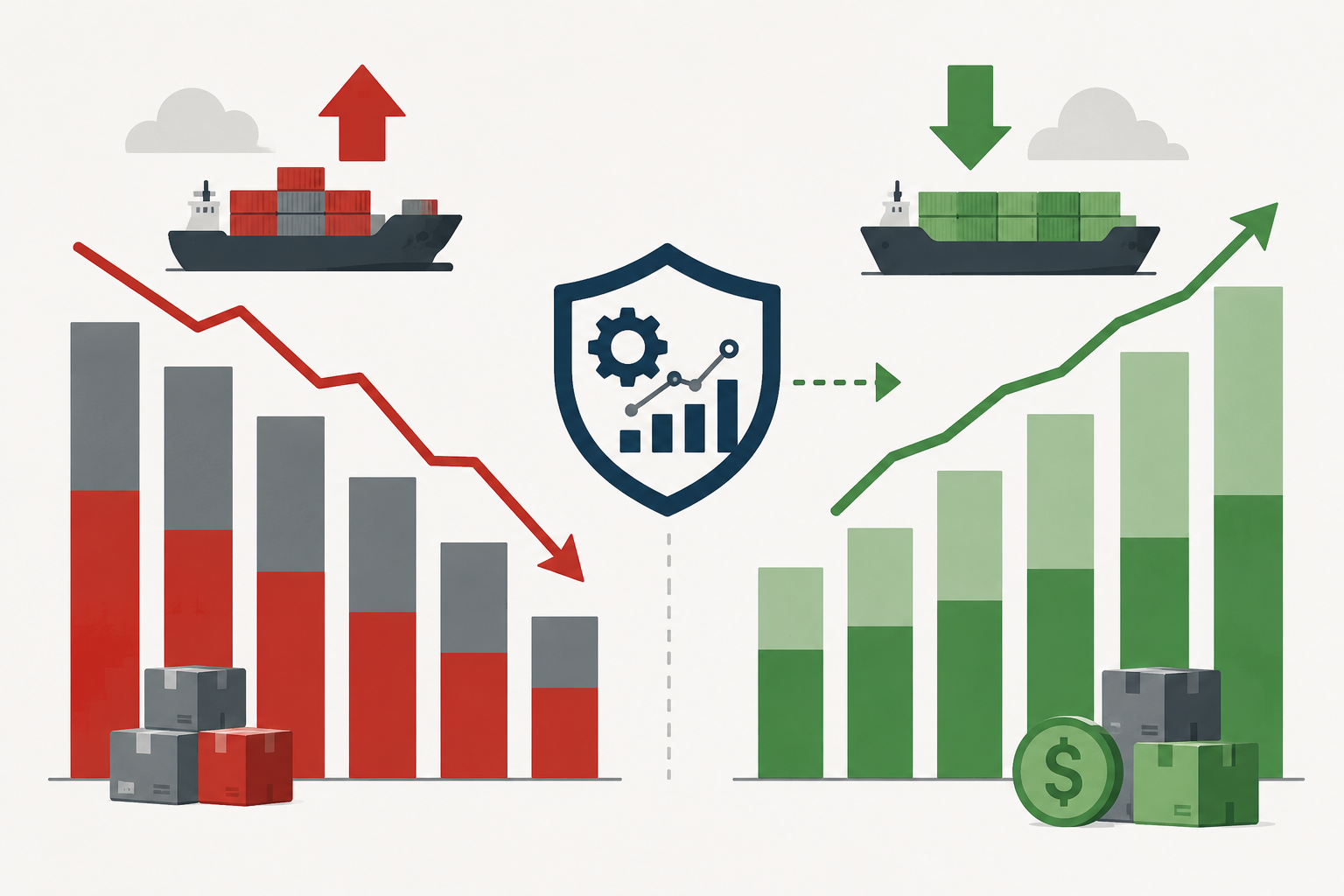
If you've submitted a proposal in the past 18 months and watched your margin quietly evaporate by the time you cut the purchase order, you're not alone. Tariff escalations on electronics and AV hardware sourced from Asia have pushed landed costs on displays, projectors, rack equipment, amplifiers, and networking gear up by 10% to 25% since early 2025, according to industry analysts and trade groups including the Consumer Technology Association.
For residential integrators handling high-ticket display and distributed audio jobs, or commercial integrators bidding on large display and videowall installations, a multi-week gap between proposal and P.O. can now mean the difference between a healthy job and one you wish you'd never bid. The painful truth: most integrators are still managing this risk with spreadsheets, gut instinct, and phone calls to their distributors. That's not a strategy. It's a prayer.
The good news? The tools to fight back are already inside your business management platform. Here's a practical framework for using D-Tools System Integrator (SI) and D-Tools Cloud to protect your margins in an unstable cost environment.
Step 1: Know Where You're Exposed Before the Bid Goes Out
The first move is identifying which product categories in your catalog carry the most tariff risk. Not every SKU is equally vulnerable. Displays, large-format panels, projectors, and passive rack infrastructure sourced from manufacturers with heavy Asia-based supply chains are at greatest risk. Networking gear, including switches, wireless access points, and cabling infrastructure, also is exposed to significant cost pressure.
Inside D-Tools, start by filtering your product catalog by manufacturer and category to surface the SKUs that have seen MSRP adjustments in the past 12 months. Cross-reference those with the products appearing most frequently on your recent proposals. That intersection of high-frequency, high-exposure products is your margin danger zone.
Run a report on your last six months of awarded jobs. How many included a large display run, a projector, or a distributed audio package sourced from tariff-affected manufacturers? If the answer is "most of them," you need a systematic response, not a job-by-job patch.
Step 2: Build Cost Buffers and Escalation Clauses into Every Proposal Template
Reactive repricing after a job is awarded is the worst place to negotiate. The time to protect yourself is before the client signs.
D-Tools SI and D-Tools Cloud both support customizable proposal templates, which means you can bake margin protection directly into your standard quoting workflow — not as an afterthought, but as a professional and defensible business practice.
Two tactics that work:
Cost buffer line items — Add a clearly labeled line item, something like "Component Cost Adjustment Allowance" or "Hardware Pricing Contingency,” set at 5 % to 10% of the hardware subtotal on any job with significant tariff-exposed product. Some integrators resist this because they fear it looks like padding.
Frame it correctly in your proposal narrative:
“Due to ongoing supply chain volatility, this proposal includes a hardware pricing contingency. Any unused contingency is returned to the client at job close."
Clients who understand the current environment (and your good commercial clients do)will respect the transparency.
Escalation clauses in proposal language — D-Tools allows you to customize proposal terms and conditions text. Add a clause explicitly stating that hardware prices quoted are valid for 30 days (or whatever your comfort window is) and are subject to adjustment based on manufacturer pricing changes prior to purchase order issuance. This is standard practice in commercial construction and increasingly expected in the AV integration world. It's not a dealbreaker, it's professionalism.
Step 3: Use Real-Time Pricing and Margin Dashboards to Spot Danger
Between proposal and purchase order, manufacturers can reprice and distributors can run out of stock and re-source at higher costs. A job that looked like 28% gross margin when you sent the proposal can look like 14% when you go to buy.
D-Tools' integration with live distributor pricing means you're not locked into the snapshot you took at proposal time. Build the habit of running a margin refresh inside D-Tools before you write up any P.O. larger than a threshold you set. The platform will flag line items where cost has moved, letting you recalculate your actual margin before you're committed.
Use the margin dashboard to set up alerts or regular reviews on open proposals and awarded jobs in the pre-purchase phase. If a job's projected margin has dropped more than a defined threshold (say, 5 points) that should trigger a conversation with your client or a review of which line items can be value-engineered before purchase.
This kind of systematic review doesn't need to be a heroic effort. It's a 15-minute weekly habit for your project coordinator or ops manager, built into your standard pre-buy workflow.
Step 4: Make Smarter Inventory Pre-Buy Decisions With Your Own Data
When tariffs ratchet up or when there's credible noise that they're about to there's a window to buy ahead and lock in current costs. But which products, in what quantities, and for how many months of pipeline?
This is where D-Tools’ standard inventory management and the new advanced Inventory Asset Management features earn their keep. Rather than making gut-feel purchasing decisions, you can use the platform to identify which tariff-exposed SKUs appear most frequently across your active proposals and projects scheduled for the next 60 to 90 days. That tells you where a pre-buy actually reduces risk versus where you'd just be tying up capital in stock you won't move for six months.
Before committing to a strategic pre-buy, run through this checklist:
-
Pipeline coverage — Do you have awarded or high-probability jobs that will consume this inventory within 90 days?
-
Storage and carrying cost — What does it cost you to warehouse this product? Does the landed cost savings outweigh it?
-
Product lifecycle risk — Is this SKU stable, or is a model refresh likely to make pre-bought inventory obsolete?
-
Distributor terms — Can you negotiate extended payment terms on a larger buy that offsets your cash flow risk?
Manufacturer pricing signals — Has this manufacturer historically passed tariff costs through quickly, or absorbed them in the short term?
D-Tools inventory management gives you the on-hand, on-order, and committed quantities by SKU, so you can see your true exposure before you call your distributor. Combine that with your proposal pipeline data and you have a defensible, data-driven case for exactly what to buy and how much.
The Bottom Line: Margin Protection Is a Process Problem, Not a Pricing Problem
Integrators who are losing margin in the current environment usually aren't making bad pricing decisions… they're making pricing decisions without a process in place. The tariff era has compressed the acceptable gap between "what we quoted" and "what we paid" to nearly zero. Informal processes that worked when hardware costs were predictable are now liabilities.
D-Tools SI and D-Tools Cloud give you the infrastructure to build a systematic response: proposal templates that price in uncertainty, live cost data that surfaces margin risk before it becomes margin loss, and inventory intelligence that turns pre-buy decisions from gambles into strategy.
The integrators who come out of this period in the best shape won't be the ones who got lucky with timing. They'll be the ones who treated margin protection as a business process and gave it the same rigor they give their rack builds.
Want to see how D-Tools SI or D-Tools Cloud can help you build margin protection into your proposal and purchasing workflow? Request a demo.
