
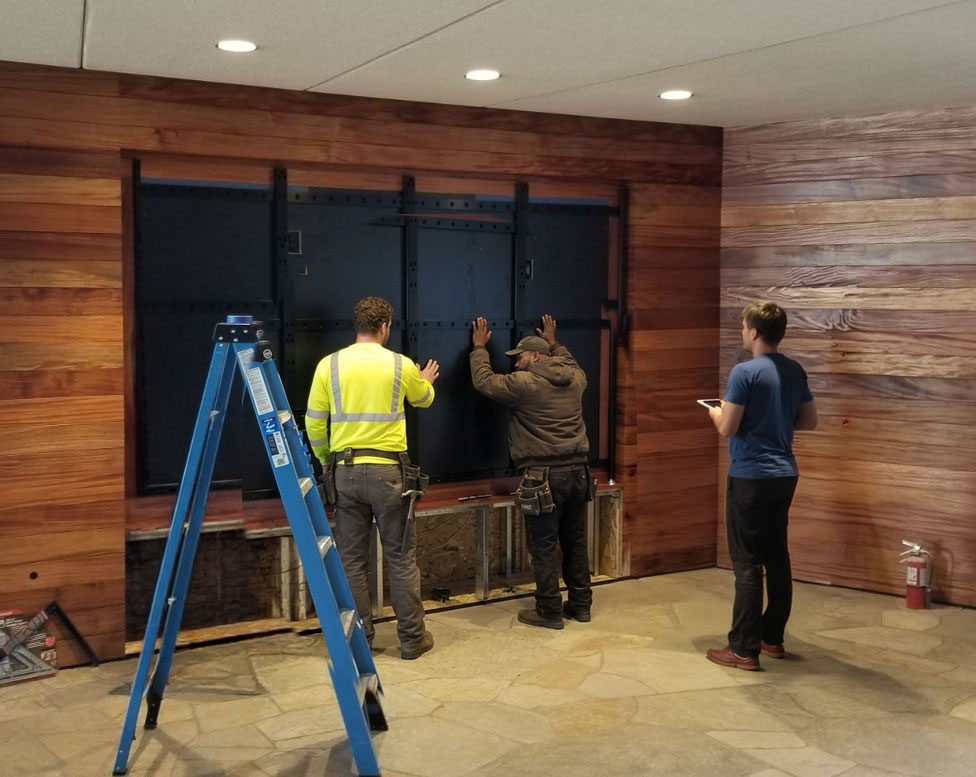
Your team just won a videowall project built on AV-over-IP. The client is thrilled, the contract is signed, and installation is underway. Then your techs discover the network switches specified in the proposal can't handle the multicast traffic load. Now you're absorbing an unplanned $8,000 in replacement hardware, and the project margin that looked healthy on paper has quietly evaporated.
That scenario is playing out across the industry more than integrators like to admit. AV-over-IP has become the default architecture for new commercial AV deployments, but it hasn't changed how most companies scope projects. Matrix-switched AV tolerated a certain amount of improvisation in that cable runs and endpoints were forgiving, and network teams rarely needed to be in the room.
AVoIP doesn't offer that same margin for error. It's a networking project wearing an AV hat, and it demands network-level precision at the design stage, not after signal problems show up on site.
The root cause of most AVoIP budget overruns isn't bad installation work, it's incomplete pre-sales documentation. Scope creep shows up when IT stakeholders get looped in after the proposal is priced, when firmware compatibility between encoders and decoders isn't verified, or when nobody asked whether the existing cable plant can actually support the bandwidth.
Integrators who build these systems inside D-Tools System Integrator (SI) and D-Tools Cloud have an edge. They can access deep manufacturer catalog data, draw signal-flow schematics (either in D-Tools Cloud Interconnect Diagrams or using Visio or AutoCAD and integrating with D-Tools SI), and attach IT documentation before a proposal and price ever go to the client. Consistently, D-Tools users will identify and catch 15% to 25% more cost variables than those scoping informally in a spreadsheet or on the back of a napkin.
5 AVoIP Design Questions to Answer
Before pricing any AVoIP proposal, your design should answer five questions:
1. Switch Capacity — Does the specified switch have the backplane throughput and port density for peak multicast load, not just average load? Map this directly to your network hardware line item in D-Tools.
2. Internet Group Management Protocol (IGMP) Snooping Configuration — Is multicast traffic properly managed, or will it flood the network? This belongs in your schematic as a documented switch configuration note, not a verbal assumption.
3. Cable Capacity — Can existing cabling support the required bandwidth and distance, or does it need to be pulled? Verify this against manufacturer specs before it becomes a change order.
4. Codec Compatibility — Do the encoders and decoders you've specified actually interoperate at the firmware versions you're deploying? Attach compatibility documentation directly to the relevant schematic elements.
5. Control Integration — How does your control system talk to the AV-over-IP infrastructure, and does that pathway need its own network segment? This should map to a distinct control line item, not get bundled into "miscellaneous."
Documentation Is Key to AVoIP Profit
Each of these decisions has a home in a D-Tools schematic. When your AutoCAD or Visio drawings, your product catalog data, and your line-item pricing all live in the same system, you get a single source of truth that carries from initial design through final installation. Nothing gets lost in translation between the sales engineer who scoped it and the technician who has to make it work.
AVoIP isn't going away, and neither is the complexity that comes with it. The integrators protecting their margins aren't the ones avoiding AV-over-IP projects, and they are the ones documenting the network layer as rigorously as the AV layer, before the proposal ever goes out the door.
