
A look at how the new Inventory Asset Management feature in D‑Tools Cloud moves AV integrators from count‑based stock management to true per‑unit asset tracking—and what that means for service, margin, and day‑to‑day operations.
Ask any seasoned integrator about their biggest day‑to‑day headaches, and somewhere on the list you’ll find a familiar one: knowing exactly which physical unit is which. Most traditional inventory systems are built around counts. They can tell you that you have twelve of a particular amplifier in the warehouse, but not which serial number is sitting on which shelf, which one was allocated to a particular project, or which one is the warranty replacement that’s about to ship out.
That gap between a product total and an actual unit is where time gets lost, margin leaks out, and service calls go sideways. D‑Tools Inventory Asset Management, the new feature soon to be released in D‑Tools Cloud, is built specifically to close that gap. Instead of treating inventory as an aggregated count, it treats every physical item as its own tracked asset with its own identity, history, and audit trail. And it is all done inside the same D‑Tools Cloud workflow you already use for sales, design, and project management.
Migrating from Counts to Unique Identities
In a count‑based system, 10 identical components are interchangeable line items: “10 in stock, five allocated, five available.”
With D‑Tools Inventory Asset Management, those same 10 components are 10 distinct records. Each one carries its own:
- Unique asset ID and serial number
- Warehouse location and bin
- Project assignment and room‑level allocation
- Scheduled date and received date
- Actual unit cost captured at receipt
- Firmware version, MAC address, and IP address
- Notes
- Full change history of who touched it, when, and what they changed
The shift sounds subtle, but operationally it’s enormous. The question your team asks changes from “Do we have one of these?” to “Which one do we have, and what do we know about it?” That single change is what D-Tools Inventory Asset Management is designed to enable.
Unifying Four Workflows Under One Data Model
Most integration businesses run four overlapping workflows that, historically, have lived in different tools or different spreadsheets:
- Warehouse intake — receiving against purchase orders, tagging product, and putting it away.
- Project allocation — reserving specific gear for specific jobs, rooms and install dates.
- Field installation — getting the right unit to the right site and confirming what was actually installed.
- Post‑install service — warranty claims, RMAs, firmware updates and repair history.
When each of these stages relies on its own list, reconciliation becomes a part‑time job. D‑Tools Inventory Asset Management unifies all four under a single per‑asset record inside D‑Tools Cloud. The unit a technician scans on the truck is the same record the warehouse received, the same record the project manager allocated, and the same record the service team will reference two years later when the warranty claim comes in.
What D‑Tools Inventory Asset Management Actually Does
A handful of core capabilities make per‑unit tracking practical at scale. Here is what the feature delivers in D‑Tools Cloud:
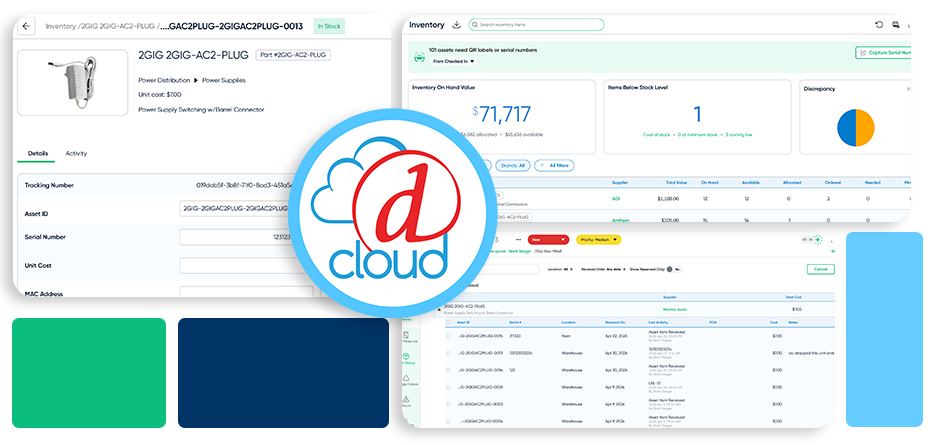
Unit-Level Asset Tracking — Every physical item becomes its own tracked asset with a unique ID, serial number, warehouse location, project assignment, scheduled date, received date, unit cost, firmware version, MAC and IP fields, notes, and a full change history. One row per physical thing, not one row per product.
QR Labels and Serial Number Linking — D‑Tools Inventory Asset Management links the physical item to its digital record by printing a QR label from D‑Tools, capturing the manufacturer’s serial number, or both. Custom label fields, batch printing with filters, and a reprintable print history keep the link intact even when tags get damaged or records change. QR labels generate as PDF at launch.
Barcode‑Scanner Workflows — Once items are labeled, the scanner becomes the primary input device. Receive against a P.O., move assets between warehouse locations, allocate to a project, or look up any unit… all by scanning. Batch mode lets you scan 50 items and move or allocate them in a single action, compressing what used to be minutes per item into seconds.
True Per‑Unit Cost Capture — Cost is captured at the moment of receipt, per asset versus being extrapolated from a rolling catalog average. Every unit carries its actual cost for the life of the record. That’s the foundation for accurate cost of goods sold, warranty valuation, and per‑asset reporting inside D‑Tools Cloud.
Unit‑Specific Project Allocation — Allocation moves from “five of these” to “these five.” D‑Tools Inventory Asset Management lets you reserve specific units to specific rooms and locations on a project. The same model extends to service calls: the record points at the exact unit that was installed, not just a generic line item from the original proposal.
A Lifetime Per‑Asset Audit Trail — Every change to every asset is logged: who changed it, when, from what value, to what value. Paired with an immutable tracking GUID, the provenance of any single asset is always recoverable even after customer‑visible IDs have been edited.
Per‑Asset Notes and Bulk Operations — Up to 3,000‑character markdown notes on any unit document damage, condition, install quirks or customer‑specific context give the technician everything he or she needs to know about that exact piece of hardware before the truck rolls. Bulk editing in a grid view, bulk label reprints, bulk moves and bulk allocations keep the model practical for warehouses with thousands of items.
Why It Matters: Where the Value Shows Up
D‑Tools Inventory Asset Management is most visible on the service side, where the cost of not knowing is the highest. But the benefits ripple across the business.
Faster Warranty and RMA Resolution — When a customer calls about a failing device, the exact unit, the purchase order it came in on, and the install date are one click away inside D‑Tools Cloud. No more digging through old proposals or guessing whether a serial number is still under coverage.
Precise Service History — Every device accumulates its own repair, firmware, calibration and maintenance record. Service calls dispatch with the actual history of the unit on the wall, not a generic product profile.
Accurate Job Costing — True per‑unit cost capture replaces catalog averages with the actual cost paid for each asset. The downstream effect is better COGS, more honest margin tracking and fewer surprises at month‑end close.
Faster Warehouse Operations — Barcode workflows in D‑Tools Cloud compress receiving, allocation and warehouse moves from minutes to seconds per item. The compounding effect across hundreds of items per week is significant.
Compliance and Chain of Custody — A complete audit trail satisfies regulatory, insurance, and audit requirements without bolting on a second system. For integrators working in regulated environments, such as government, healthcare or financial services, this can be the difference between winning a contract and being disqualified.
Loss Prevention and Accountability — Serialized tracking makes theft, swaps, and “ghost inventory” harder to hide. Because every movement is logged against a unit and a user, accountability is built in so there are fewer “it walked away” moments, and a clear answer to who had what and when.
Smarter Forecasting and Upsell — Visibility into installed components surfaces patterns that aggregate counts hide: bad batches, high‑failure units, customers due for upgrades, and opportunities to refresh aging gear with newer product lines.
Who Benefits Most
D‑Tools Inventory Asset Management delivers the most value to integrators whose workflows depend on knowing which physical unit is which, not just how many they have. The sweet spot includes operations that involve:
- Service calls that need to identify the exact unit installed
- Compliance, audit or chain‑of‑custody requirements
- Per‑unit cost accuracy for job costing and margin tracking
- Warehouses large enough that “which shelf, which box?” is a real question
- Operations that are sometimes plagued by “lost” or “disappearing” products, not just from the warehouse, but from the vans and jobsites
- Warranty and RMA work tracked by serial number
For smaller shops doing primarily new‑construction installs with limited service needs, D-Tools Cloud’s traditional count‑based inventory management solution may still be sufficient. But for any integrator with a meaningful service business, a growing warehouse footprint, or customers in regulated industries, the per‑unit tracking in D‑Tools Inventory Asset Management quickly stops being a nice‑to‑have and starts being foundational.
What’s Not in the Initial Release of Inventory Asset Management
In the interest of being upfront, here is what D‑Tools Inventory Asset Management does not include in the initial release. These capabilities are on the roadmap, but they are not part of the launch:
- RMA / Warranty workflows — a dedicated RMA and warranty‑claim workflow is not part of the first release, though the per‑asset history that supports it is.
- Thermal printer integration — QR labels generate as PDF at launch; direct integrations for Brother and Zebra thermal printers are coming, but are not in the initial release.
- Hybrid pooled vs. asset mode — the initial release does not support running pooled (count‑based) and per‑asset tracking side by side on the same catalog.
- Mobile app / field‑user workflow — a dedicated mobile app and field‑technician experience is on the roadmap, but the launch experience is browser‑based.
The Bigger Picture
D‑Tools Inventory Asset Management isn’t just a better inventory module, it’s a different mental model for how a system integration business relates to its hardware. When every physical unit has its own identity, history and audit trail inside D‑Tools Cloud, an entire category of guesswork disappears from daily operations. Receiving, project allocation, service, warranty work, and margin management all draw from the same source of truth.
That’s the kind of foundational shift that compounds. The integrator who knows exactly which unit is which doesn’t just save time on individual tickets, he or she builds a more defensible, more profitable, and more scalable business over the long run. That’s the transformation D‑Tools Inventory Asset Management is designed to enable.
