

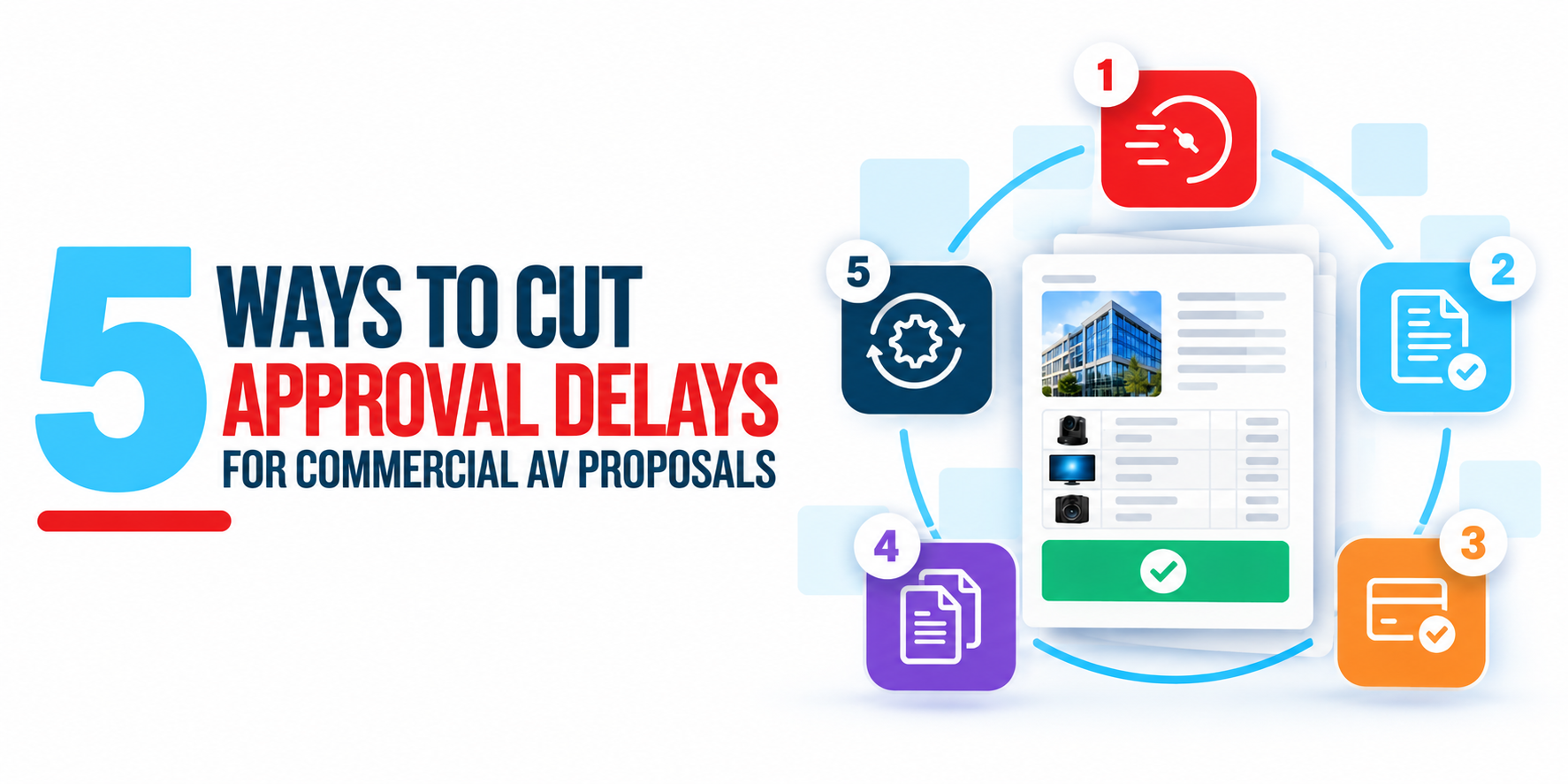
Quick answer A commercial AV quote stalls when it goes out late and then waits on paper sign-off. Five changes move it faster. Send the proposal within 48 hours, build it from current product data, let the client accept and pay in one step, keep every revision in one place, and connect the proposal to the rest of the job. D-Tools data shows proposals presented within 48 hours close at 88%.
Why Do Commercial AV Quotes Stall?
In a perfect world, you turn around a finished, highly polished proposal for a commercial client within 48 hours, deliver the quote in person and watch the customer sign the contract on the spot and give you a deposit. Okay, you can wake up from the dream now.
The reality is that you got busy and didn’t deliver the quote for weeks, it went through several revisions before you emailed the quote, and a week or more later it was still sitting in the client’s inbox while a facilities director waited on finance and another bid was landing on the same desk.
Delays in getting a signature rarely come from the price. They come from the days between "we need this" and the "yes” from the client.
Below are five ways AV proposals move faster, and what to look for when you evaluate a platform.
1. Send AV Proposals within 48 Hours
Speed starts before the client ever reads the proposal. D-Tools data shows thatproposals presented to clients within 48 hours close at 88%, while those that take a month or more close at a lower 69% rate.
The same need for speed shows up at every step of the sale. The client who waits two weeks for a proposal has two weeks to talk to someone else. A faster proposal cycle is one of the clearest ways to win more deals, faster. Moreover, a delay in getting the proposal to the client can be perceived as a tacit way of letting them know it’s okay to sit on the quote and not respond immediately. New AI-Assisted Workflows built into D-Tools Cloud enable integrators to find products faster and build proposals quicker.
2. Build Proposals from Real Product Data
Slow approvals often start with a question from the client such as: Is this price right, or is this component still available?
D-Tools Cloud builds proposals from its Integrated Product Library, which holds more than 2 million manufacturer-sourced items. Current data means less inputting product and model numbers by hand, fewer corrections after you send the proposal, and fewer restarts when a customer spots a potentially questionable line item or price.
D-Tools data shows that a commercial AV proposal with more than 500 line items will on average go through eight to nine revisions. Again, more revisions equals more time, which again sets the tone that it’s OK for the customer to sit on the proposal for a longer period of time.
3. Let the Client Accept and Pay in One Click
Sometimes, the longest gap can occur after the client has decided to approve your proposal. The customer say yes, and then someone on your team has to print, sign, scan and send an invoice for the deposit.
D-Tools Payments closes that gap. The client accepts the proposal electronically via signature and the request for an initial equipment deposit immediately takes place within the same communication. The client has the option to pay electronically by ACH or credit card, which means instant cash flow for your business. (With Accelerated ACH in D-Tools Payments, funds arrive in one business day instead of four.)
One-click payment requests eliminate the need to send another email to be sent (sometimes weeks later). It is not uncommon for a commercial customer to get the follow-up payment request email and have forgotten what the payment is even for. Long delays can diminish excitement for the project in general.
4. Keep Revisions and Change Orders in One Place
Commercial AV proposals rarely survive first contact unchanged. The client adds a room, a consultant swaps a display, and the version that gets approved is not the one you sent. The approval time gets slower if each revision lives in a different email thread. Having a platform where the revised scope and change orders sit in one record makes its easier for the client to approve the most current version.
5. Choose a Platform that Connects the Whole Job
Many integrators run sales on one system and delivery on another. In the 2025I Am Sayen Software Stack Survey, 67.5% of integrators reported little or no integration between their software. Every gap between those tools is a place where an approval can stall. According to data from the Commercial Integrator Software & Business Report, the average pro AV integration company uses between four and five different software solutions to run their business. Logically, the more pieces of software in use, the greater the risk for incompatibility and the need for double (or triple) inputting. Every time data is required to be transferred from one piece of software to another via manual means, it is a chance for a mistake.
D-Tools is the Integration Business Platform for the technology integration industry. Its end-to-end platforms support sales, design, project management and service operations for thousands of companies across 90-plus countries.
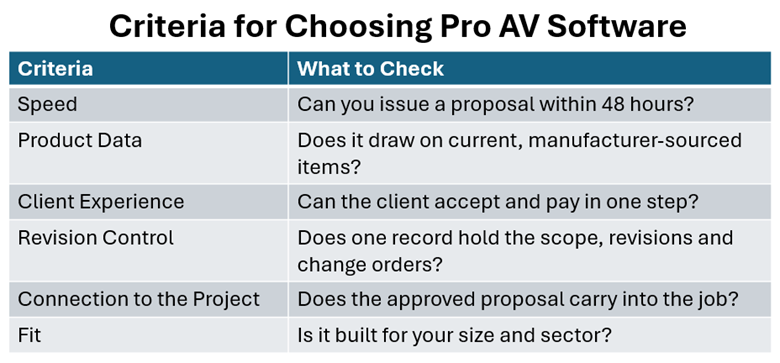
Test your own proposal process against the criteria above. Try D-Tools Cloud with a free 30-day trial.
Frequently Asked Questions
Q: What is the best way for integrators to build AV proposals?
A: The best approach builds proposals from current manufacturer product data, sends them within 48 hours, lets clients accept and pay online, and connects to the project afterward. Judge any option on those four points, then confirm it fits your size and sector. D-Tools Cloud is AV integrator software built for growing integration businesses, residential and commercial.
Q: How do proposals built in one platform reduce rework across commercial AV project lifecycles?
A: Rework often comes from a gap between what was sold and what gets ordered, installed and billed. When the proposal and the project share the same product data, the scope the client approved is the scope your team works from during AV installation. Fewer re-entries mean fewer mismatches to fix later.
Q: What makes a cloud platform critical for commercial AV project management?
A: Commercial AV approvals involve several reviewers, often in different places. Cloud-based AV project management software gives everyone one current version from any device, and the same record can follow the job into design, delivery and service. That removes version confusion, a common cause of approval delay.
Q: How do faster proposals affect win rates and profitability?
A: D-Tools data shows an 88% close rate for proposals presented within 48 hours. Accurate pricing protects margin, and online payment shortens the wait for cash. With Accelerated ACH, funds arrive in one business day instead of four.
