
How productive is your proposal creation process? Are you able to turn them around quickly? How many revisions is your norm? Do you start from scratch on every proposal? How are you benefitting from the use of AI?
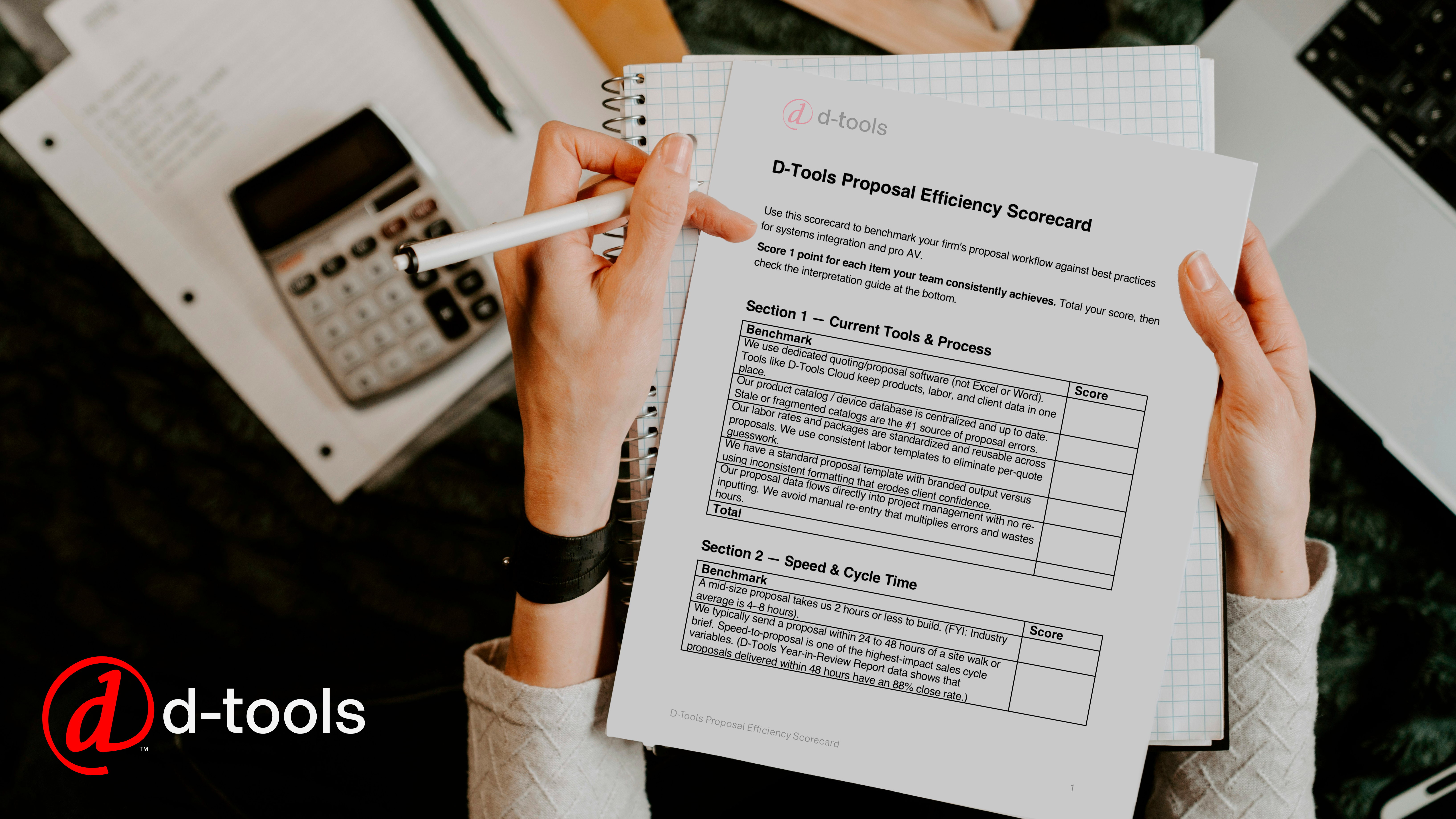
Those are all giant questions to ask yourself when evaluating the efficiency of your proposal creation acumen. D-Tools has put together this simple 1 to 20 scorecard you can use to help identify where your gaps might be. Print out this scorecard and write in your score to each question, then add them up and see how you are faring.
Use this scorecard to benchmark your firm's proposal workflow against best practices for systems integration and pro AV.
Score 1 point for each item your team consistently achieves. Total your score, then check the interpretation guide at the bottom.
Section 1 — Current Tools & Process
■ We use dedicated quoting/proposal software (not Excel or Word). Tools like D-Tools Cloud keep products, labor, and client data in one place. SCORE: ___
■ Our product catalog / device database is centralized and up to date. Stale or fragmented catalogs are the #1 source of proposal errors. SCORE: ___
■ Our labor rates and packages are standardized and reusable across proposals. We use consistent labor templates to eliminate per-quote guesswork. SCORE: ___
■ We have a standard proposal template with branded output versus using inconsistent formatting that erodes client confidence. SCORE: ___
■ Our proposal data flows directly into project management with no re-inputting. We avoid manual re-entry that multiplies errors and wastes hours. SCORE: ___
Section 2 — Speed & Cycle Time
■ A mid-size proposal takes us 2 hours or less to build. (FYI: Industry average is 4–8 hours). SCORE: ___
■ We typically send a proposal within 24 to 48 hours of a site walk or brief. Speed-to-proposal is one of the highest-impact sales cycle variables. (D-Tools Year-in-Review Report data shows that proposals delivered within 48 hours have an 88% close rate.) SCORE: ___
■ Revision turnaround (client change requests) takes less than 1 hour, depending on the complexity. Fast revision response reduces deal uncertainty and buyer anxiety. SCORE: ___
■ We rarely need more than two revision rounds to get a signed proposal. High revision counts signal scope gaps that start during proposal creation. (D-Tools data shows that large projects with more than 500 line items require an average of 8 to 9 revisions.) SCORE: ___
■ We can handle 3+ simultaneous active proposals without quality degradation. Capacity is a leading indicator of process maturity and tooling health. SCORE: ___
Section 3 — Accuracy & Margin Control
■ Accessories and complementary products are consistently included in quotes. Missed accessories are a top source of change orders and margin erosion. SCORE: ___
■ We review gross margin at the line-item level before sending proposals. Aggregate margin review misses the low-GP items that sink project profitability. SCORE: ___
■ We have a minimum-margin threshold and flag quotes that fall below it. Without a hard floor, scope creep silently compresses margins over time. SCORE: ___
■ Scope-of-work language is generated from the actual products and labor in the quote. Disconnected SOW writing leads to mismatched client expectations. (D-Tools Cloud has a built-in AI agent that can write the SOW in three different styles, depending on the customer.) SCORE: ___
■ Post-project, we compare proposed vs. actual margins at least quarterly. Proposal accuracy only improves with closed-loop data from completed jobs. SCORE: ___
Section 4 — AI & Automation Readiness
■ Our team can find and add products using descriptions, not just model numbers. Natural-language product search, such as part of D-Tools Cloud, dramatically reduces catalog lookup time. SCORE: ___
■ We can apply a margin adjustment to an entire proposal section in one step. Bulk financial logic cuts repricing time from 30 minutes to seconds. SCORE: ___
■ Scope-of-work drafts are generated automatically from quote contents. AI scope generation is typically the highest single-task time savings. SCORE: ___
■ Our quoting tool uses historical job data to suggest labor hours. Data-informed labor estimates reduce under-bid risk on complex installs. SCORE: ___
■ We regularly evaluate new tools or features that reduce proposal time. Continuous tool evaluation is a hallmark of high-growth integration firms. SCORE: ___
TOTAL SCORE (out of 20) ___ / 2 0
Score Interpretation:
Score 0–8 -- You Are in the Manual Process Risk Zone
Your team is leaving real revenue on the table. Manual quoting in Excel or Word drives slow turnarounds, missed accessories, and inconsistent margins. Every additional proposal taxes your team’s bandwidth and raises the risk of costly change orders downstream.
Recommended next moves:
■ Adopt D-Tools Cloud as your single source of truth for products, labor and client data. Pulling everything into one system immediately eliminates the duplicate entry and formatting drift that come with Word and Excel quotes.
■ Import your top 100 most-used products from D-Tools’ built-in manufacturer catalogs so estimators stop hand-typing model numbers and pricing.
■ Build one branded D-Tools Cloud proposal template that every quote starts from, so client-facing output stays consistent no matter who is writing the proposal.
■ Set a 90-day goal to cut average proposal build time in half, and track it inside D-Tools so the gains are visible to the whole team.
Score 9–13 -- You Have a Developing Workflow
You have the basics in place, but inconsistent process is still costing you speed and margin. The next jump in efficiency comes from connecting proposal data to project execution and from automating your pricing logic.
Recommended next moves:
■ Use D-Tools Cloud’s integrated project workflow so accepted proposals flow directly into installation tasks. Stop re-keying parts, labor and scope between systems.
■ Build reusable labor packages in D-Tools (for example, “single-display conference room” or “four-zone audio install”) that bundle hours by phase and remove per-quote guesswork.
■ Set a minimum gross-margin threshold in your D-Tools settings and require approval on any line item or section that falls below it before the proposal leaves the office.
■ Train your sales team on D-Tools Cloud’s bulk margin adjustment so they can reprice an entire section in seconds instead of rebuilding the quote from scratch.
Score 14–17 -- You Have an Efficient Operation
You’re operating well above the industry average. From here, the biggest gains come from AI-driven automation and from using your historical project data to sharpen estimates and protect margin.
Recommended next moves:
■ Turn on D-Tools Cloud’s AI scope-of-work agent and pick a default writing style (technical, executive, or client-friendly) that matches your typical buyer.
■ Use D-Tools Cloud’s natural-language product search to onboard new estimators in days instead of weeks — they can find products by description without memorizing model numbers.
■ Run a quarterly proposed-vs-actual margin review using D-Tools project data to surface the categories where you’re consistently under-quoting labor or missing accessories, then tune your templates accordingly.
■ Adopt a “proposal in 24 hours” SLA for mid-size opportunities. D-Tools Cloud templates and historical data make this achievable, and faster delivery measurably improves your close rate.
Score 18–20 -- You Are an AI-Ready Leader
You’re already running a high-performance proposal engine. Your job now is to compound the advantage — treat D-Tools as a strategic moat rather than a single tool, and use your data to keep pulling ahead of the field.
Recommended next moves:
■ Deploy new D-Tools Cloud AI features the moment they ship — natural-language search, automated SOW generation, historical-data-driven labor suggestions, and bulk financial logic — and put them in customer-facing workflows first.
■ Use closed-loop data from D-Tools (proposed vs. actual margin, win rate by speed-to-proposal, revision counts by project type) to drive quarterly process refinement.
■ Expand D-Tools usage into adjacent revenue streams — change orders, service contracts, and recurring monthly agreements — so the same data layer powers your entire customer lifecycle, not just the original sale.
■ Codify your playbook and mentor newer integrators in your market. Consider becoming a D-Tools reference partner; top-tier firms benefit from sharing process insights and staying connected to the product roadmap.
Wherever your score lands, D-Tools Cloud is built to move you up the curve. With embedded AI for natural-language product search, instant section-level margin adjustments, and automated scope-of-work generation, most teams cut proposal time in half within the first month. Reach out to schedule a demo and we’ll walk through exactly where your workflow can pick up speed.
